How to Tell You’re in an Anxiety Spiral — and How to Get Out of It
Anxiety was never meant to run the show.
It was designed as a survival instinct — a quick internal alarm to protect us from immediate danger. Think: being attacked by a lion while hunting for dinner. Your body would surge with adrenaline, your focus would narrow, and you’d either fight or run. Problem solved (or at least attempted).
But in today’s world, we’re not running from lions.
We’re anxious about cancel culture, toxic relationships, constant comparison, global crises, work performance, social media judgment, and the darker sides of humanity — all abstract, ongoing threats with no clear endpoint. And yet, our nervous system reacts the same way it would to a physical attack.
This mismatch is what fuels the anxiety spiral.
Our fight-or-flight system is incredibly good at responding to short-term danger, but it struggles with modern stressors that are vague, chronic, and impossible to “escape.” When that alarm stays on too long, anxiety starts feeding itself — looping thoughts, escalating fear, and pulling you further away from clarity.
Recognizing when you’ve entered an anxiety spiral is the most important step in stopping it.
What an Anxiety Spiral Actually Looks Like
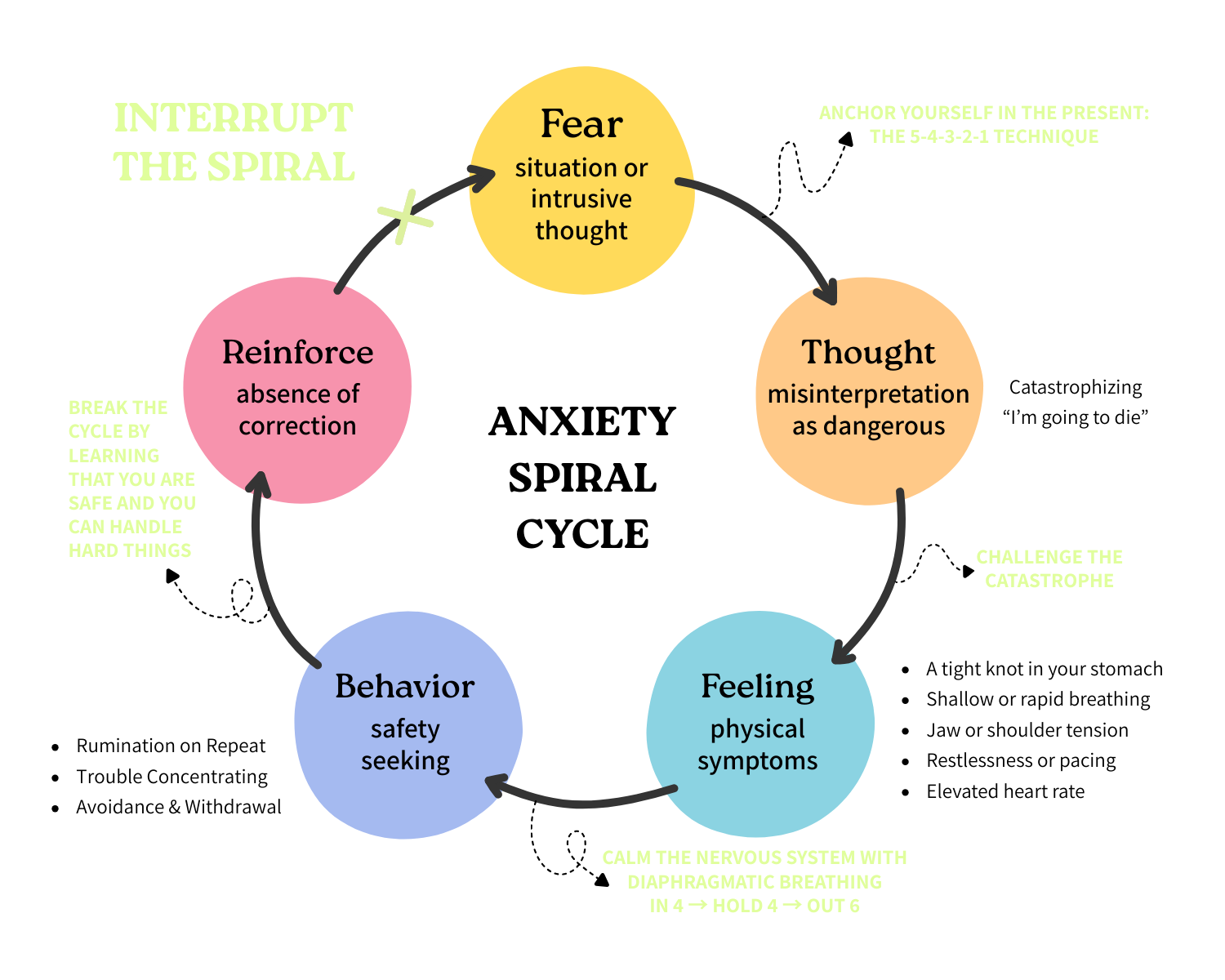
An anxiety spiral is more than just feeling stressed or overwhelmed. It’s when one worry triggers another, and then another, until your brain and body feel hijacked.
Here are some common signs:
Mental Overdrive
Your thoughts feel uncontrollable. One concern quickly turns into ten. You jump straight to worst-case scenarios, assume the absolute worst outcome, and struggle to slow your mind down. This is classic catastrophizing.
Physical Symptoms
Your body gets involved fast. You might notice:
A tight knot in your stomach
Shallow or rapid breathing
Jaw or shoulder tension
Restlessness or pacing
Elevated heart rate
Your body is reacting as if danger is present — even when it isn’t.
Avoidance and Withdrawal
You start avoiding people, conversations, tasks, or situations that might trigger anxiety. While this feels protective in the moment, it often makes the spiral worse by shrinking your world and reinforcing fear.
Trouble Concentrating
The constant internal noise makes it hard to focus, be productive, or finish tasks. This often leads to frustration, guilt, and self-criticism — which feeds the spiral even more.
Rumination on Repeat
You replay past interactions or future hypotheticals over and over, searching for certainty or reassurance that never actually comes.
If you’ve ever thought, “Why can’t I just stop thinking about this?” — you were likely in a spiral.
How to Interrupt the Spiral (Not “Make Anxiety Go Away”)
The goal isn’t to eliminate anxiety instantly — that usually backfires. The real objective is to interrupt the loop and bring your rational brain back online.
Here’s how.
1. Anchor Yourself in the Present: The 5-4-3-2-1 Technique
Anxiety pulls you into imagined futures. Grounding pulls you back into what is actually happening right now.
Try this:
5 things you can see
4 things you can touch
3 things you can hear
2 things you can smell
1 thing you can taste
This isn’t about distraction — it’s about telling your nervous system, “I am safe in this moment.”
2. Calm the Nervous System with Diaphragmatic Breathing
Your vagus nerve plays a major role in calming your body. Slow, intentional breathing sends a biological signal that the “threat” has passed.
Try this pattern:
Inhale through your nose for 4, letting your belly expand
Hold for 4
Exhale slowly through your mouth for 6
Repeat 5–10 times.
The longer exhale is what helps activate the calming response.
3. Challenge the Catastrophe
Anxiety feels convincing — but feelings are not facts.
Instead of arguing with yourself, gently separate the thought from reality by asking:
Is this 100% true right now?
What is the most likely outcome?
What is one small step I can take next?

Why This Matters
Anxiety is powerful — but it’s not always accurate.
Learning to recognize when you’re in an anxiety spiral and knowing how to interrupt it is a modern survival skill. You don’t need to eliminate anxiety to regain control. You just need to stop letting it run unchecked.
With practice, these tools become less about “fixing” anxiety and more about trusting yourself to navigate it.
And that’s where real relief begins.
Want Support Beyond Reading About It?
If anxiety spirals feel frequent, intense, or hard to interrupt on your own, you don’t have to figure it out alone.
Therapy can help you better understand your anxiety patterns, calm your nervous system, and build practical tools that actually work in real life — not just in theory.
If you’d like more support learning how to manage anxiety, you’re welcome to schedule a therapy session to work through this together.