Nervous System Regulation Skills & Coping Menu

(Because You Don’t Need One Perfect Coping Skill)
When people feel anxious, overwhelmed, shut down, or irritable, the first question is usually:
“What’s the right thing to do to calm down?”
The nervous system doesn’t work that way.
There isn’t one perfect skill. There isn’t one universal fix. And trying to find “the right” tool often creates more pressure than relief.
Instead of searching for the correct answer, it can be more helpful to build a Regulation Menu — a flexible list of options you can choose from depending on what your body actually needs.
Why a “Menu” Works Better Than a Plan
Rigid plans trigger the same stress response many of us are trying to calm.
A menu:
Offers choice instead of obligation
Encourages flexibility instead of perfection
Reduces all-or-nothing thinking
Supports autonomy
Regulation improves when the nervous system feels safe — and safety increases when we experience choice.
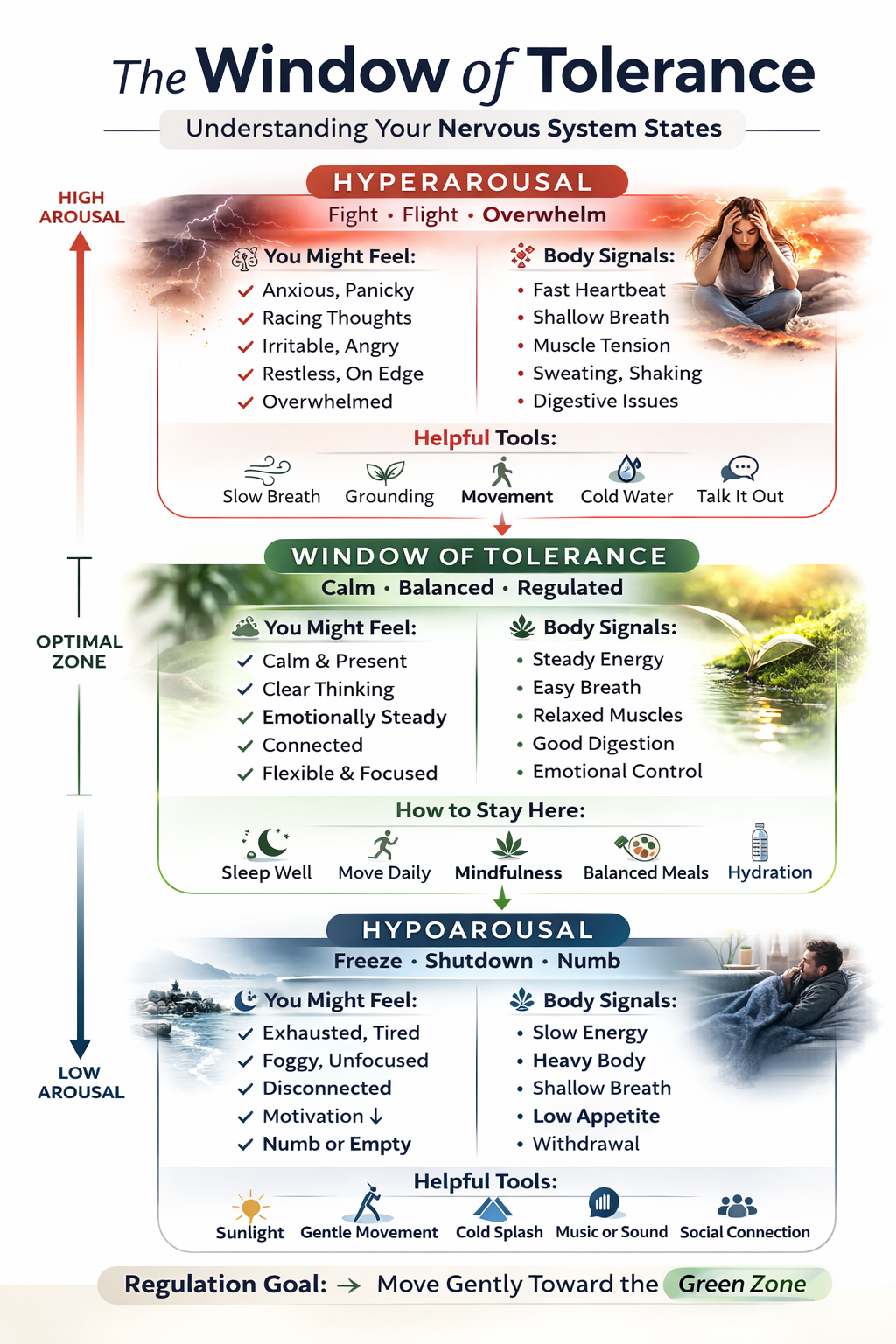
Identify Your Nervous System State
Before choosing a skill, it helps to notice your current state.
You might be:
🔺 Activated (Fight-or-Flight)
Racing thoughts
Restlessness
Irritability
Tension in chest or jaw
Feeling “on edge”
🔻 Shut Down (Freeze / Dorsal)
Heavy or foggy
Low energy
Numb or disconnected
Wanting to withdraw
Difficulty initiating tasks
⚖️ Somewhere in the Middle (Window of Tolerance)
Able to think clearly
Emotionally steady
Present
Regulation is not about always feeling calm.
It’s about gently moving back toward your window of tolerance.
The Nervous System Regulation Menu
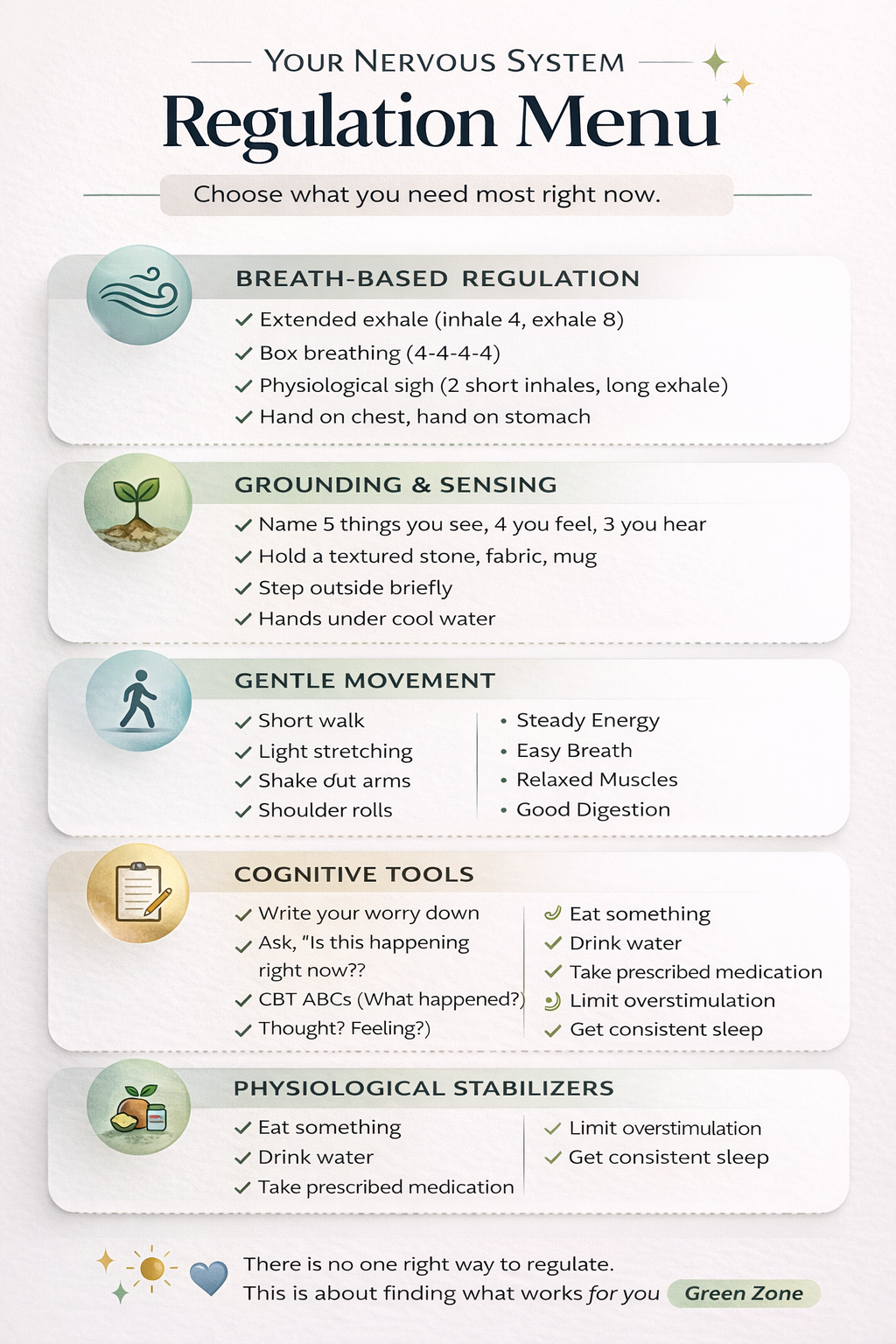
Think of this as categories, not commands.
You don’t need to do everything. You just need options.
🌬️ Breath-Based Regulation (For Activation)
When anxiety is high, the goal is slowing the system down.
Try:
Extended exhales (inhale 4, exhale 6–8)
Box breathing (4–4–4–4)
Physiological sigh (two short inhales, slow exhale)
Placing one hand on your chest and one on your stomach
Why it works:
Longer exhales stimulate the vagus nerve, signaling safety to the body.
🌿 Grounding Through the Senses
When thoughts feel loud, bring attention outward.
Try:
Naming 5 things you see, 4 you feel, 3 you hear
Holding something textured (stone, fabric, mug)
Stepping outside briefly
Running hands under cool water
Why it works:
Grounding interrupts rumination and shifts attention from internal threat to present-moment safety.
🚶 Gentle Movement (For Activation or Stuck Energy)
Movement helps discharge stress hormones.
Try:
A short walk
Light stretching
Shoulder rolls
Slow pacing while on a call
Shaking out arms and legs
Why it works:
The nervous system evolved for movement. Physical discharge reduces physiological stress buildup.
🔥 Up-Regulation (For Shut Down States)
If you feel numb or frozen, the goal is gentle activation.
Try:
Cold water on your face
Turning on bright lights
Playing energizing music
Stepping outside briefly
Small task initiation (wash one dish, fold one towel)
Why it works:
Shutdown states need safe stimulation to return to engagement.
🍽️ Physiological Stabilizers
Sometimes what feels emotional is actually biological.
Support your system by:
Eating regularly
Drinking water
Sleeping consistently
Taking prescribed medication as directed
Limiting overstimulation
Blood sugar instability, dehydration, and sleep deprivation can all mimic anxiety or irritability.
Regulation starts with the body.
🧠 Cognitive Regulation (When Thoughts Are Driving the Spiral)
If rumination is high, add structure to thinking.
Try:
Writing down the worry
Asking: “Is this happening right now?”
CBT ABC framework (What happened? What did I think? How did I feel?)
Replacing “What if?” with “Even if…”
Why it works:
The brain often calms when it feels organized.
🛋️ Containment & Soothing
Not every state requires activation.
Sometimes the most regulating option is:
Sitting with a blanket
Watching something familiar
Listening to calm music
Reducing sensory input
Doing less
Regulation is not productivity.
How to Choose What to Do
Instead of asking:
“What’s the best coping skill?”
Ask:
“What does my body need more of right now — slowing down or waking up?”
If you’re wired → choose slowing.
If you’re shut down → choose gentle activation.
If you’re steady → maintain with consistency.
There is no gold star for picking the hardest option.
Why Motivation Often Follows Regulation
People often say:
“I know the skills, I just don’t do them.”
That’s not a character flaw.
When your nervous system is dysregulated, the prefrontal cortex (planning, decision-making) becomes less accessible.
Regulation restores access to:
Clear thinking
Emotional flexibility
Motivation
You don’t need more willpower.
You need more regulation.
Redefining “Coping”
Coping isn’t about eliminating emotion.
It’s about:
Increasing flexibility
Shortening recovery time
Building trust with your body
The goal isn’t to never feel anxious or low.
The goal is:
“I know how to come back.”
Build Your Own Menu
Write down:
3 things that calm you
3 things that energize you
3 things that stabilize your body
1 person you can reach out to
Keep it somewhere visible.
You don’t need a perfect system.
You just need accessible options.
Final Thought
The nervous system doesn’t respond to criticism.
It responds to safety.
A Regulation Menu isn’t about controlling your body — it’s about learning how to work with it.
And the more flexible you become, the more resilient you feel.