What Is Brainspotting? A Simple Guide to How It Works (And Why It Helps)
If you’ve heard me mention brainspotting in session, you might be wondering:
“What exactly are we doing?”
“Why am I staring at a spot?”
“How is this actually helping my anxiety / trauma / body reactions?”
Let’s break it down in a way that actually makes sense.
What Is Brainspotting?
Brainspotting is a therapeutic approach that helps your brain and body process and release stored emotional experiences, especially ones that feel “stuck.”
It works by using your eye position to access parts of your brain where those experiences are stored.
Instead of talking about a problem over and over, brainspotting helps your brain process it at the source.
The Simple Version
Here’s the easiest way to understand it:
👉 Where you look affects how you feel.
Certain eye positions connect to specific emotional and bodily experiences. When we find the right “spot,” your brain begins to process what’s been stuck—often without needing to put everything into words.
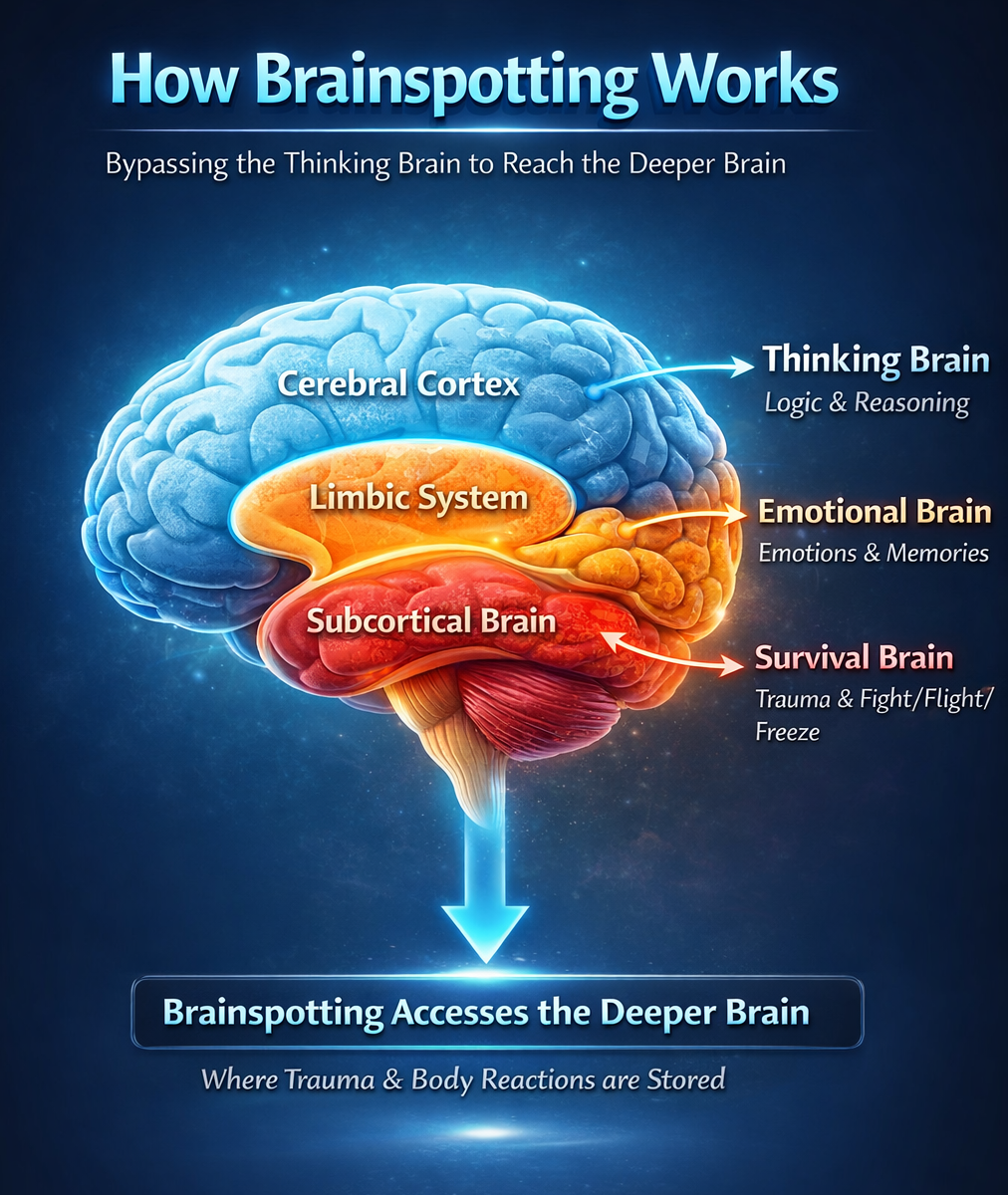
How the Brain Is Involved
To understand why brainspotting works, it helps to know a little about how your brain processes experiences.
The “Thinking Brain” vs. the “Feeling Brain”
Cerebral Cortex (Thinking Brain)
This is your logical, problem-solving brain. It helps you analyze, plan, and make sense of things.Limbic System (Emotional Brain)
This is where emotions, memory, and survival responses live.Subcortical Brain (Deeper Brain Regions)
This includes areas involved in automatic responses—like fight, flight, freeze, and stored trauma.
Why Talking Isn’t Always Enough
A lot of difficult experiences are stored in the subcortical brain, not the logical one.
That’s why you might think:
“I know I’m safe… but I still feel anxious.”
Your thinking brain understands—but your deeper brain hasn’t fully processed it yet.
How Brainspotting Works
Brainspotting helps bypass the thinking brain and access the deeper parts of the brain where experiences are stored.
Here’s what happens in a session:
We identify something activating (emotion, memory, body sensation)
We find a corresponding eye position (brainspot)
You hold your gaze there
Your brain begins to process—often through:
body sensations
emotions
images
shifts in awareness
You don’t have to “figure it out.”
Your brain does the work.
What Are “Trauma Capsules”?
Sometimes experiences don’t get fully processed when they happen—especially if they were overwhelming.
Instead, they get “stored” in the brain and body.
You can think of these as:
👉 Trauma capsules = unprocessed emotional experiences frozen in time
Brainspotting helps your brain reprocess and release these capsules so they’re no longer activated in the same way.
Common Brainspotting Terms (Glossary)
Here are some key terms you’ll hear during sessions:
SUDS (Subjective Units of Distress Scale)
A 0–10 scale used to measure how intense something feels.
0 = no distress*
10 = highest distress*
*I prefer the term “activated” over “distressed.”
This helps us track shifts during processing.
Brainspot
A specific eye position that connects to stored emotional or somatic experiences.
Activated Spot
An eye position that increases emotional or body activation.
This helps us access what needs to be processed.
Expansion Spot
An eye position that brings calm, openness, or relief.
We may use this for regulation or resourcing.
Resource Spot
A spot connected to feelings of safety, grounding, or strength.
Helpful when things feel overwhelming.
Vergence
This technique uses eye near and far focus to deepen processing.
Varying focus—close to distant—boosts brain efficiency in accessing and processing material.
Processing
The internal experience that happens while holding a brainspot—this can include:
thoughts
emotions
body sensations
memories
or even just subtle shifts
What Does Brainspotting Feel Like?
It varies from person to person.
You might experience:
emotional waves (sadness, relief, anger, etc.)
body sensations (tightness, warmth, release)
memories or images
feeling tired or deeply focused
or even “nothing obvious” (and it’s still working)
There’s no “right” way to do it.
Benefits of Brainspotting
Clients often notice:
Emotional Benefits
Reduced anxiety and reactivity
Less emotional overwhelm
Improved ability to tolerate feelings
Trauma Processing
Desensitization to triggering memories
Reduced “stuck” feeling
Increased sense of closure
Nervous System Regulation
Feeling calmer in your body
Less fight/flight activation
Improved sleep and physical relaxation
Performance & Growth
Improved focus and clarity
Reduced self-doubt or blocks
Greater connection to self
Why Brainspotting Can Feel Different Than Talk Therapy
Talk therapy uses your thinking brain.
Brainspotting works with your processing brain.
That’s why you might notice:
less talking
more internal experience
deeper, faster shifts
Both approaches are valuable—but they do different things.
What You Need to Know Going Into Brainspotting
You Are in Control
You can always pause, stop, or shift at any time.
You Don’t Have to Explain Everything
Your brain can process without needing a full narrative.
It Might Feel Weird at First
That’s normal. It’s a different way of working.
Your Brain Knows What to Do
You don’t need to “try” to make something happen.
Final Thought
Brainspotting isn’t about forcing change.
It’s about creating the conditions where your brain can finally do what it was designed to do:
👉 process, heal, and move forward
Book Your Brainspotting Session Today
If you’re curious about whether brainspotting could help you, we can explore it together in session.
You don’t have to keep carrying things that feel stuck.
👉If you are already my client, let’s talk in our next session :)
👉If you don’t have a session on the books, log into your client portal to book now!
👉If you want to get unstuck, book a FREE CONSULTATION with me now!